
I.AI Consulting & Training

Futuristische Serverumgebung mit leuchtendem Visa-Logo und digitalen Datenströmen.

03/26, AI Models & Tools, EU & GER

26/03/2026

Visa builds AI payment systems

Visa is developing infrastructure to enable payments initiated by AI agents, signaling a move toward “agentic commerce,” where transactions occur without direct human involvement. Through its “Agentic Ready” program, the company supports banks and partners in preparing for secure and scalable AI-driven payments, initially focusing on Europe.

These systems allow AI to make purchases independently within predefined limits while users retain overall control. Visa is also working on industry standards, authentication methods, and fraud prevention measures to build trust in automated transactions. This initiative strengthens Visa’s competitive position in the rapidly evolving digital payments landscape.

Updates from the world of artificial intelligence

Recent News

Visa is developing infrastructure to enable payments initiated by AI agents, signaling a move toward “agentic commerce,” where transactions occur without direct human involvement.
Munich-based Agile Robots has entered into a strategic partnership with Google DeepMind. As part of the collaboration, DeepMind’s “Gemini Robotics” foundation models will be integrated into Agile Robots’ systems.
ChatGPT has introduced a simplified interface that replaces direct model selection with general modes like “Instant,” “Thinking,” and “Pro.” This obscures which AI model is actually being used.
Google is experimenting with AI-generated headlines in its search results, sometimes replacing the original titles of articles with AI-created alternatives. This often happens without the authors’ consent.
The growing spread of AI writing tools means that even genuinely human text can quickly seem suspicious. Clear, highly polished writing is now often associated with AI.
More than ten years after the failed Fire Phone, Amazon is reportedly working on a new AI-focused smartphone. The project is said to carry the codename “Transformer”.
As energy demand continues to rise, three key levers are emerging to make data centers more sustainable. These include infrastructure, cooling methods, and management.
The US Treasury has released a comprehensive AI risk management guide for financial institutions, aimed at standardizing AI use and enhancing accountability. Built on existing standards, the framework includes over 230 control objectives across the entire AI lifecycle.
The Hachette Book Group has withdrawn the horror novel Shy Girl by Mia Ballard following allegations that parts of the book were created using AI. Originally self-published and later released in the UK, the novel was scheduled for a US launch.
Around the world, more people are selling their personal data, including videos, voice recordings, and private messages, to AI training platforms for small payments. This creates a new form of gig work driven by tech companies' demand for human-like training data.
A contract has been signed in Stuttgart for the construction of the AI supercomputer “HammerHAI.” The project is a key initiative within Europe’s AI Factories program and will be operated by the High-Performance Computing Center Stuttgart.
Europe is at a crucial turning point in the AI race with the United States and China. Leaders and investors emphasize that the region needs to make better use of its strong research base and highly skilled workforce.
A report by the World Economic Forum shows that companies need to fundamentally transform to unlock the full potential of AI. The key is aligning strategy, workforce, and operating models, rather than treating AI as just another tool.
Recent research shows that while modern AI can excel at many games, it often struggles with tasks that require understanding underlying mathematical functions. In games like Nim, current AI training approaches fail.
OpenAI has developed a new feature for ChatGPT that creates interactive visual explanations for over 70 topics in math and science. Instead of just producing static text, users can now work with dynamic diagrams.
Five creative prompts show how Claude, the AI chatbot by Anthropic, can generate far more meaningful responses. By giving the AI a clear role, perspective, or structure, even complex topics become simpler and easier to understand.
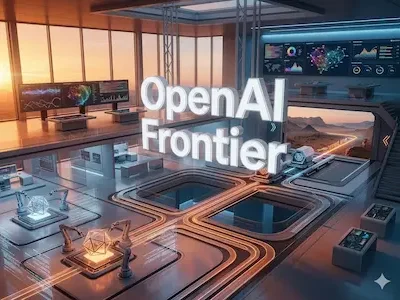
Frontier, OpenAI’s new enterprise platform, enables the creation, deployment, and management of AI agents. These agents function like “AI coworkers,” with shared context, identity, permissions, and performance tracking across business systems.
Databricks has introduced Genie Code, an AI agent capable of autonomously handling complex tasks for data teams, freeing engineers from routine work. Its capabilities range from building data pipelines to monitoring production systems.
Several leading technology and retail companies, including Google, Microsoft, Meta, Amazon, and OpenAI, have joined a voluntary industry agreement to combat online fraud and scams.
Artificial intelligence is fundamentally transforming the cybersecurity landscape. It provides new defensive capabilities but also introduces significant risks.

The EU plans to adjust the EU AI Act through a so-called “Omnibus” package. As part of this move, the deadlines for regulations affecting high-risk AI systems will be extended.
At this year’s European Congress of Radiology in Vienna, experts presented a visionary outlook for radiology in 2050. It is expected to be heavily supported by artificial intelligence, while still guided by human expertise.
According to a new analysis by Anthropic, artificial intelligence is more likely to reshape many jobs than eliminate them entirely. The study examined how the AI assistant Claude is used in practice.
Switzerland aims to influence the global semiconductor industry by promoting open-source chip technology, helping prevent dominance by a few countries and companies.
There is an increasing gap between the hype surrounding artificial intelligence and the actual benefits it delivers for businesses. Studies indicate that up to 95% of AI pilot projects fail, primarily due to weak data strategies and insufficient foundations.
Meta has announced it will allow rival AI chatbots on WhatsApp in Europe for the next year, following EU antitrust pressure that saw competitors blocked from the platform in January. Starting immediately, companies can connect their AI chat services to WhatsApp via its Business API, although Meta will charge access fees.
On March 6, Anthropic launched the "Claude Marketplace," an app store dedicated to Claude-powered tools. This platform allows businesses to spend their existing Claude credits on third-party AI plugins built on the Claude ecosystem.
On March 5, OpenAI unveiled ChatGPT for Excel in beta, directly integrating GPT-5.4 into spreadsheets. With this new add-in, users can ask ChatGPT to build or update Excel models using their own data and formulas through natural language prompts.
French startup Mistral AI released Mistral 3, a comprehensive suite of new open models. The lineup features three "Ministral 3" models (with 3B, 8B, and 14B parameters) tailored for on-device use, alongside the massive 41B-parameter "Mistral Large 3," which utilizes a sparse mixture-of-experts architecture totaling 675B parameters.
German startup Black Forest Labs recently raised $300 million in a Series B funding round, pushing its valuation to an impressive $3.25 billion. Known primarily for its open-source Flux image models, the Freiburg-based company has quickly become one of Europe’s most prominent generative AI firms.
The U.S. Department of Defense formally designated Anthropic’s Claude AI as a "supply chain risk." Consequently, no Pentagon projects are permitted to use Claude or its derivatives for at least the next year.
Google has officially rolled out Nano Banana 2, its most advanced image generation and editing model yet, directly integrated into Gemini. Designed to bring your wildest ideas to life at breathtaking speed, this powerful tool leverages broad general knowledge and advanced reasoning to deliver exceptionally high-quality visual outputs.
As artificial intelligence rapidly transforms the corporate landscape, security concerns continue to hold many organizations back. To solve this trust deficit, JetStream Security has officially emerged with a massive $34 million seed round led by Redpoint Ventures.
Munich-based startup Proxima Fusion has taken a monumental step toward clean energy by signing a memorandum of understanding with the Free State of Bavaria, RWE, and the Max Planck Institute for Plasma Physics. This groundbreaking partnership outlines a strategic roadmap to construct Europe's first commercial fusion power plant.
German startup Navel Robotics is set to deploy 100 of its empathetic social robots in nursing homes. Designed to tackle the growing shortage of caregiving staff, the AI-powered robot, named Navel, serves as an interactive companion for elderly residents.
OpenAI is officially rolling out advertisements to ChatGPT users on its Free and Go plans, signaling a major shift in how the popular AI assistant is monetized. While the company claims these ads will remain clearly labeled and visually separate from responses, this move raises significant privacy and user experience concerns.
Tech giant Google is set to open a new Artificial Intelligence development center in Berlin, marking a significant milestone in its €5.5 billion investment drive across Germany. The state-of-the-art facility will serve as a collaborative hub, uniting cloud computing, data infrastructure, and advanced AI development.
French quantum computing pioneer Pasqal is set to make a massive leap into the public markets following an agreement to merge with special purpose acquisition company Bleichroeder. This landmark transaction values the Paris-based scaleup at an impressive $2 billion and paves the way for a Nasdaq listing in the second half of 2026.
Google has just launched Lyria 3, its latest generative music model from DeepMind, now available directly within Gemini. This powerful new tool allows you to easily create personalized, 30-second music tracks complete with vocals and lyrics.
OpenAI is reportedly developing a new subscription tier for its popular AI chatbot called ChatGPT Pro Lite. Priced at approximately $100 per month, this upcoming option aims to bridge the significant gap between the standard $20 Plus tier and the premium $200 Pro version.
OpenAI CEO Sam Altman recently addressed growing concerns about the massive energy and water consumption of artificial intelligence. Pushing back against what he considers unfair comparisons, Altman argued that training a human also requires significant resources.
OpenAI has announced a staggering $110 billion in new investment, bringing its valuation to an unprecedented $730 billion. This monumental funding round features massive contributions from tech giants, including $50 billion from Amazon, $30 billion from NVIDIA, and $30 billion from SoftBank.
A recent post on the Reddit community r/singularity has gone viral for showcasing how an "infamously bad" anime can be completely visually overhauled using Seedance.
The Qwen team has officially launched Qwen3.5, introducing its highly anticipated open-weight model, Qwen3.5-397B-A17B. This native vision-language model delivers outstanding performance across various benchmarks, excelling in complex reasoning, coding, and multimodal agent capabilities.
Employees at Google and OpenAI have signed an open letter titled “We Will Not Be Divided,” calling on their companies to back Anthropic in its dispute with the U.S. Pentagon.
In 2026, Windows 11 introduces a range of practical AI features designed to boost productivity, creativity, and accessibility. At the center is Copilot, which answers questions, drafts text, manages settings, and now responds to the voice command “Hey Copilot.”
When exploring how artificial intelligence can be used effectively in everyday life, it’s important to recognize potential risks, including privacy issues, job displacement, and misinformation.
Germany is stepping up its efforts in the field of industrial AI in order to keep pace with the USA and China in the global competition for smart manufacturing and robotics. Among other things, the Industrial AI Cloud was recently launched.
European semiconductor startup Axelera AI has secured over $250 million in its latest funding round, bringing its total capital raised to more than $450 million.
Companies are increasingly turning to separated cloud architectures to strengthen their AI data governance in response to stricter regulatory requirements and operational challenges.
Visa is developing infrastructure to enable payments initiated by AI agents, signaling a move toward “agentic commerce,” where transactions occur without direct human involvement.